After a hailstorm, the dents might look small, but the disruption feels big. Your car suddenly looks different, light no longer flows smoothly across the hood and roof, and what once felt new now feels worn.
You want the fastest and smartest path back to a clean, factory-like finish without paying for repairs that aren’t truly necessary. You also don’t want to be without your vehicle for weeks while layers of paint dry and panels get rebuilt.
This guide explains how Paintless Dent Repair for Hail Damage can often reduce turnaround time and lower overall costs, what truly affects repair speed and pricing, and why starting with a free hail inspection gives you clarity instead of guesswork.
Why hail repairs can take longer than expected, and how PDR changes that
Traditional body repair involves several rebuilding stages that naturally extend timelines. Damaged areas are sanded down, filled to restore shape, primed for paint, repainted to match surrounding panels, and then allowed to cure before blending work finishes the surface. Each step requires time, materials, and careful scheduling. When storm seasons hit, these stages can stretch even longer as shops manage high volumes of vehicles waiting for paint booths and drying space.
Paintless Dent Repair changes this timeline by preserving the original surface. Instead of rebuilding the panel, technicians reshape the metal itself back into its factory form. Because there is no filler, primer, or paint curing involved, many of the waiting periods disappear. Repairs focus entirely on restoring the panel’s shape, which often results in faster completion.
There is also an aesthetic advantage to fewer steps. When factory paint remains untouched, reflections stay clean and uninterrupted. The vehicle looks naturally smooth again instead of subtly “reworked,” which is a common visual side effect of refinishing.
What Paintless Dent Repair for Hail Damage Really Is
Paintless Dent Repair is a specialized technique where technicians use precision tools behind the panel or controlled surface methods to massage dents out slowly and accurately. Rather than forcing metal back into place, the process involves gentle pressure and constant reflection monitoring to recreate the original surface shape.
Hail damage is especially suited for PDR because most hailstones create shallow depressions without breaking paint. These small dents often spread across roofs, hoods, trunks, and upper doors, which are ideal surfaces for careful reshaping. With the right lighting and experience, even clusters of dents can be restored cleanly.
Speed never replaces craftsmanship in quality PDR work. Even when repairs move quickly, each panel must be checked from multiple angles to ensure there are no ripples, high spots, or uneven reflections. When done right, the repaired area should blend seamlessly into the surrounding surface.
Lower cost explained and why PDR often saves money
One of the main reasons PDR costs less in many hail situations is the elimination of repainting steps. Traditional repairs require labor for sanding, filling, priming, painting, and blending. They also involve paint materials, masking supplies, and curing time. PDR removes most of these expenses by focusing purely on reshaping metal.
Overall pricing still varies depending on several real-world factors. The total number of dents across the vehicle matters significantly, as does how dense those dents are across each panel. Roof and hood access can affect labor time, especially in vehicles with complex interior structures. Metal type also plays a role, since aluminum panels behave differently from steel. The sharpness and depth of each dent influence how long it takes to restore cleanly, and paint condition determines whether PDR is possible at all.
Beyond immediate savings, preserving factory paint adds long-term value. Original finishes age naturally and reflect light consistently, while repainted areas can show subtle differences in texture or color over time. Vehicles with intact factory paint typically maintain stronger resale appeal.
When PDR is the right choice and when it isn’t
Paintless Dent Repair works best when dents are smooth, shallow, and the paint surface remains intact. It is especially effective across wide panels that have many small impacts where repainting would introduce unnecessary risk and expense. In these situations, PDR restores appearance while keeping the vehicle as original as possible.
However, some damage requires traditional repair methods. Sharp creases, cracked paint, or metal that has stretched beyond its natural shape may not return cleanly through PDR alone. In these cases, a blended approach often delivers the best result, using PDR wherever possible and refinishing only the areas that truly need it.
Honest evaluation matters more than one-size-fits-all promises. A quality repair team explains what can be restored with PDR and what requires other methods during a proper free hail inspection, ensuring the final result looks consistent across every panel.
What a proper free hail inspection includes and why it prevents delays
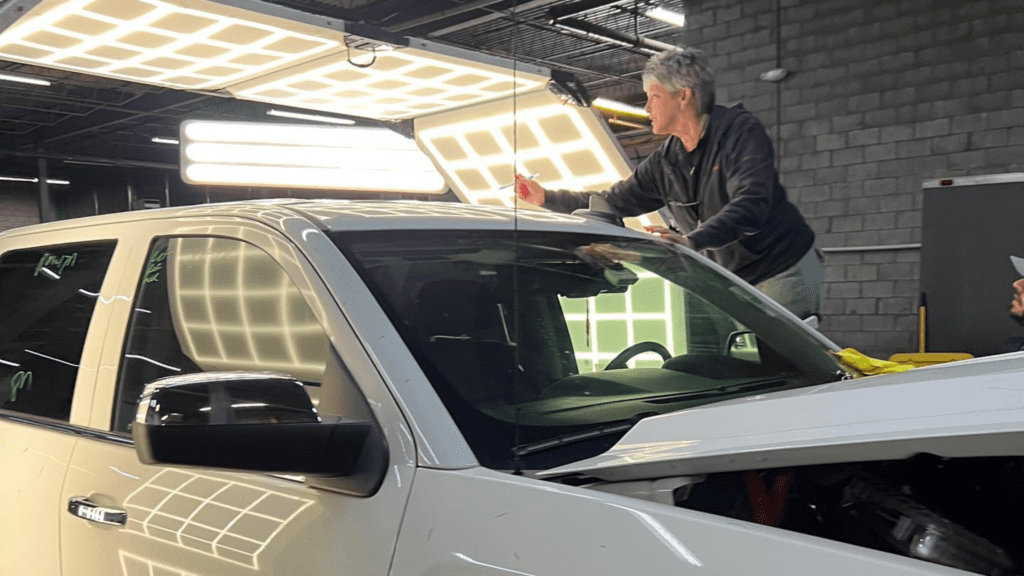
A thorough hail inspection goes far beyond a glance. Technicians examine each panel under specialized lighting designed to reveal dents hidden in shade or cloudy conditions. Roofs receive particular attention because damage there is often missed without reflection tools.
Dent mapping plays a major role in this process. Each dent is documented panel by panel, so no damage is forgotten. Missed dents are one of the most common reasons hail repairs stretch longer than expected, as they lead to rework and additional appointments later.
Paint and surface conditions are also carefully checked. Clear coat integrity, previous repair areas, and subtle cracks all influence which repair methods will produce the cleanest outcome. At the end of the inspection, you should walk away with a clear understanding of the damage scope, recommended repair approach, and realistic timeline. This is always a free hail inspection focused on clarity, not a rushed estimate.
Turnaround time factors that speed up or slow down repairs
Repairs move faster when inspections are thorough from the start,t and dent mapping leaves nothing unaccounted for. Skilled PDR technicians who follow consistent processes can restore panels efficiently without sacrificing finish quality. Clear scheduling and communication also reduce downtime between repair stages.
Delays often occur during peak storm seasons when regional damage overwhelms shop capacity. Missed dents discovered mid-repair can require revisiting panels that were already completed. Repairs involving repainting add curing time and blending stages that naturally extend timelines.
Final quality checks protect both your time and your results. Multi-angle lighting inspections and natural sunlight reviews ensure that no imperfections remain, preventing callbacks or touch-up appointments later.
Mistakes that slow repairs or leave visible flaws
Choosing the quickest option without understanding quality control often leads to subtle surface ripples. These imperfections may not appear under shop lighting but become obvious in bright sunlight. A properly restored panel should look calm and smooth, not busy or uneven.
Skipping documentation removes accountability. Before-and-after photos and detailed repair notes ensure that every dent was addressed and that the final finish meets restoration standards.
Waiting too long after a major storm can also create delays. Early inspections help secure repair timelines before backlog builds across the region.
How to choose the right PDR hail repair team
Speed and quality come from specialization. Teams that focus heavily on hail damage understand dent patterns, metal behavior, and proper restoration techniques. Strong inspection systems with dent mapping ensure no damage is overlooked.
Clear communication matters just as much as technical skill. Predictable updates, transparent timelines, and accessible support make the repair process far less stressful.
During your free hail inspection, asking about which panels qualify for PDR, how roof dents are identified, what quality checks are performed, and how progress updates are handled reveals a shop’s professionalism. Vague explanations, sweeping promises without inspection, or confusion about free estimates instead of inspections are common red flags.
Real-world hail repair outcomes
Vehicles with minor dents across the hood and trunk often look heavily damaged in sunlight despite shallow impacts. Through careful PDR and reflection checks, these panels can return to smooth, factory-like surfaces with no visible repair traces.
Moderate hail damage across roofs, hoods, and fenders benefits greatly from dent mapping. By identifying every impact from the start, technicians restore uniform panel reflections and prevent the patchy look that occurs when dents are missed.
Severe storms sometimes require blended repairs. In these situations, PDR restores most panels, while isolated cracked areas are refinished carefully. When done correctly, the final appearance remains visually unified across the entire vehicle.
Conclusion
Paintless Dent Repair for Hail Damage is often preferred because it reduces repair steps, shortens turnaround time, and preserves your vehicle’s original finish. Clean reflections and factory paint are what people notice first, and PDR keeps those details intact.
The right solution always depends on dent depth, paint condition, and panel access, which is why inspection matters more than quick promises. When restoration is done well, the surface becomes smooth again, light flows evenly across every panel, and the storm’s marks quietly disappear.
Schedule a free hail inspection with The Hail Group to confirm whether PDR is the right solution for your vehicle, understand the true scope of damage, and move forward with a repair plan built around skilled craftsmanship, consistent communication, and a factory-like finish, without calling it a free estimate.
Frequently asked questions
Is Paintless Dent Repair (PDR) less expensive than traditional hail repair?
Yes, Paintless Dent Repair is often more cost-effective than conventional body repair because it avoids labor-intensive sanding, priming, and repainting. Material costs are lower as well, making it an efficient solution for dents where the paint remains intact.
How long does PDR take compared to traditional repair?
Repair time depends on the severity and density of the hail damage. Many PDR jobs are completed faster than conventional repairs because the process focuses on reshaping the metal rather than repainting entire panels, while still ensuring a smooth, factory-like finish.
Can roof dents be repaired with PDR?
Yes, Roof dents are commonly repaired using PDR, provided technicians have proper access behind panels and utilize controlled lighting to identify every dent. Careful dent mapping ensures no damage is missed, even in hard-to-see areas.
What if the paint is cracked or damaged?
Cracked, chipped, or flaking paint usually requires conventional refinishing. In these cases, PDR alone may not restore the panel’s appearance or protect it properly, so a blended approach may be recommended for the best overall finish.
Does PDR harm factory paint or clear coats?
When performed correctly, PDR does not damage the factory paint or clear coat. Skilled technicians use precise tools to manipulate the metal beneath the surface, preserving the original finish and reflections.How is the severity of hail damage determined?
The most reliable way to assess hail damage is through a professional free hail inspection. Technicians evaluate dent depth, density, metal condition, and paint integrity to determine whether PDR, conventional repair, or a blended approach is the right solution.

Josh Jones has been a pivotal part of The Hail Group for over 8 years, bringing his expertise in automotive repair, particularly in hail damage and Paintless Dent Repair (PDR). With a background in both technical and customer-facing roles, Josh is passionate about providing clear, informative content to help consumers make informed decisions about their vehicle maintenance. His goal is to simplify complex topics and ensure that every reader walks away with practical knowledge.
