The storm is over, but your car’s surface tells the story in tiny shadows that appear and disappear as the light moves. What looked fine in the driveway suddenly shows ripples when the sun hits just right, and those quiet dents begin to feel louder with every reflection. You don’t want to guess at repairs or rush into repainting panels that could have been restored while keeping the factory finish. This guide breaks down how to Fix Hail Damage on a Car the right way by looking at dent size, where the dents landed, and whether the paint is still intact, starting with a free hail inspection that reveals what the eye often misses.
See the Damage the Way a Technician Sees It
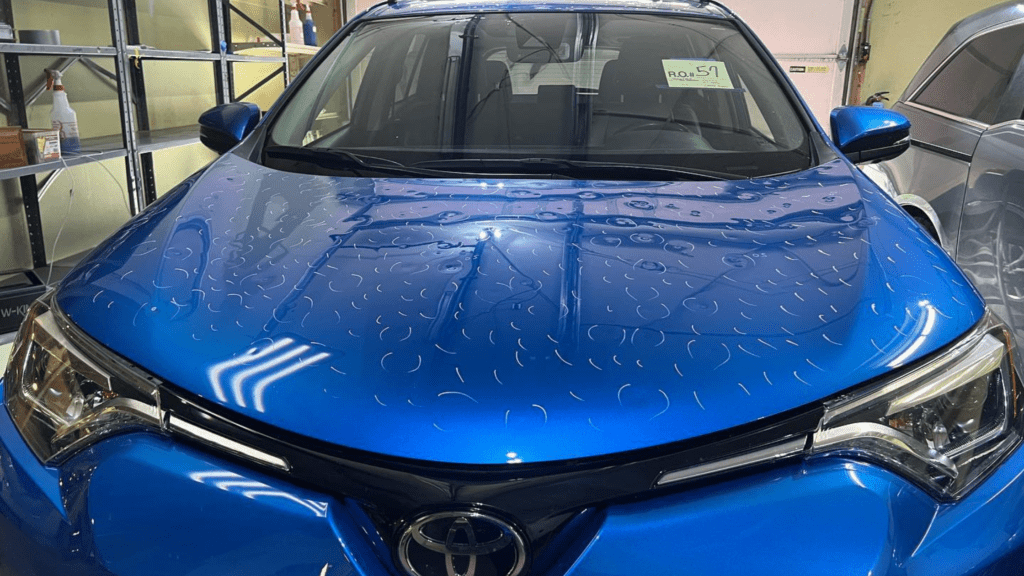
Hail dents are deceptive because they behave differently in different lighting. In soft shade, many dents seem to disappear, making the damage feel minor or even invisible. Under direct sunlight or angled garage lighting, those same spots suddenly show broken reflections where smooth gloss should be. This is why people often underestimate hail damage after a storm and only realize its true extent days later when the light changes.
Before your inspection, a quick at-home visual check can help you understand what you’re dealing with. Walking slowly around the vehicle in sunlight while changing angles allows you to see reflections stretch and bend across panels. Looking across the surface instead of straight at it helps reveal low spots more clearly. Roofs and hoods are common false calm areas because they often look untouched until light glides across them, exposing clusters of shallow dents.
This is also why a free hail inspection matters more than guessing. Professionals use controlled lighting designed to highlight depth, density, and metal movement so nothing is missed. It’s not a free estimate, and it isn’t a sales shortcut. It’s a technical assessment that shows exactly how much damage is present and which repair methods will actually restore the surface cleanly.
Dent Size and Shape: How They Guide the Repair Method
Small, shallow dents are often the most responsive to Paintless Dent Repair when the paint remains intact. These dents usually form when hail impacts lightly but frequently, creating dozens or even hundreds of impressions that bend the metal without breaking the finish. While each dent may seem minor, their density across a roof or hood can make damage significant, which is why technicians evaluate overall coverage rather than single marks.
Medium dents introduce more complexity because shape begins to matter as much as size. A smooth, bowl-shaped dent where the metal moves gradually often responds well to skilled reshaping. Technicians look closely at how the metal stretched and whether it can return cleanly without leaving high spots or distortion. When movement is soft and even, restoration is usually possible with careful technique.
Sharp dents and creases are where decisions become stricter. When hail strikes near an edge or body line, the metal can fold abruptly, stretching more severely. This increases the risk of visible waves if pushed improperly. In many cases, most of the vehicle may still qualify for paintless repair, while a few sharp impacts require conventional work, leading to a blended repair approach that protects the overall finish.
Location Matters: Where the Dents Landed Changes Everything
Roof damage is among the most common after hailstorms and also the easiest to underestimate. Roof panels often hold dozens of shallow dents that blend until revealed under proper lighting. Because of limited visibility and structural braces beneath the metal, precise dent mapping becomes essential to avoid leaving scattered imperfections behind.
Hood and trunk dents demand an especially clean finish because flat panels show distortions immediately. Even slight ripples can disrupt reflections and make repairs obvious. Skilled repair focuses not just on flattening metal but on restoring the smooth flow of body lines so the surface reads naturally in sunlight.
Doors, fenders, and edges introduce tighter curves and stiffer metal. These areas resist movement more strongly and often crease instead of bending softly. Access behind the panel also affects feasibility, as braces and supports can limit tool positioning. Location alone can change both repair time and method, even when dent size appears similar.
Paint Condition Is the Gatekeeper
Intact paint is often the deciding factor in whether paintless repair can be used. Factory paint consists of multiple bonded layers designed for durability and a uniform finish. When the clear coat remains unbroken, the metal beneath can often be reshaped without refinishing, preserving the original appearance and resale value.
Recognizing paint damage after hail is critical. Cracks, spider-web patterns, chipped edges, exposed primer, or flaking clear coat signal that the finish has been compromised. When this happens, the goal shifts from preserving paint to restoring protection and appearance through proper refinishing.
Repainting isn’t inherently bad, but it requires careful blending, texture matching, and gloss control so panels don’t look different under sunlight. Quality workmanship ensures repaired areas blend seamlessly into surrounding surfaces rather than standing out as patched sections.
Choosing Between PDR, Traditional Repair, or a Blended Plan
Paintless Dent Repair is typically the best option when paint remains intact, and dents range from shallow to moderate without sharp creasing. It’s especially efficient when numerous dents cover large areas like roofs and hoods because it avoids sanding, priming, and repainting while preserving the factory finish.
Traditional body repair becomes necessary when paint is cracked, metal is severely stretched, or creases won’t return cleanly. This method involves reshaping, surface preparation, and refinishing to restore structural integrity and appearance. When done properly, it delivers durable, consistent results.
A blended plan often offers the smartest outcome when most dents qualify for PDR, but a few areas require conventional repair. This approach ensures the entire vehicle reads as one smooth, unified surface rather than a mix of restored and distorted panels.
What a Proper Free Hail Inspection Should Include
Dent mapping is one of the most important parts of inspection. Each panel is evaluated and documented to create a repair blueprint, ensuring no dents are forgotten or underestimated. Missed dents are one of the biggest reasons repairs feel incomplete later.
Technicians also assess material type, as aluminum and steel respond differently to reshaping. Structural braces and access points beneath panels influence technique and time required. These factors help determine the most effective repair strategy.
After inspection, you should receive a clear explanation of recommended methods and realistic expectations on finish quality and timeline. This is where free hail inspection language matters, because the goal is accuracy and transparency rather than rushed pricing.
Mistakes That Can Undermine Results
Treating minor-looking damage as minor work is a common error. Dozens of small dents across a roof can require extensive precision, even though each dent appears shallow. Rushed repairs often leave subtle waves that become visible weeks later under different lighting.
Speed over finish quality leads to high spots and uneven reflections. Proper repairs include multiple-angle checks and sunlight verification to ensure surfaces flow naturally.
Skipping documentation and final walk-throughs reduces confidence and resale value. Before-and-after records and natural light inspections ensure every dent has been addressed properly and consistently.
How to Choose the Right Hail Repair Team
Specialization matters. Teams that focus heavily on hail damage bring greater skill in PDR and dent mapping rather than treating it as occasional work. A structured inspection process paired with multi-light quality checks signals attention to detail.
Communication is equally important. Predictable updates, clear timelines, and honest explanations reduce stress throughout the process. You should understand exactly what happens next and why specific methods are chosen.
Asking the right questions during your free hail inspection helps set expectations. Understanding which dents qualify for PDR, how roof damage is tracked, what the finish will look like in sunlight, and how repairs are documented gives clarity and peace of mind.
Real-World Repair Paths
When small dents cover the roof and hood with paint intact, paintless repair is often preferred. Dent mapping ensures none are missed, and quality checks restore smooth reflections so the surface reads cleanly again.
Medium dents on the hood combined with sharper impacts near an edge often call for a blended approach. Most dents can be reshaped while sharper creases receive traditional repair to protect overall finish consistency.
Severe storm damage with cracked paint on one panel typically requires conventional refinishing there, while the rest of the vehicle may still benefit from PDR. This maintains a unified appearance without unnecessary repainting.
Bringing It All Together
Learning how to Fix Hail Damage on a Car starts with three truths. Dent size and shape reveal how the metal moved. Location shows what’s hardest to restore cleanly. Paint condition determines whether you can preserve the factory finish or need refinishing. When the right method is chosen, the surface becomes quiet again, reflections smooth out, body lines return, and the storm stops showing up in the light.
For drivers across the USA looking for clear answers and professional care, scheduling a free hail inspection with The Hail Group provides a detailed, panel-by-panel assessment of dent size, dent location, and paint condition, along with a repair plan built for clean results and consistent communication, not a free estimate.
FAQs About Hail Repair
Can you fix hail damage on a car without repainting?
Yes, many vehicles can be restored without repainting when the paint is intact, and the dents are suitable for Paintless Dent Repair (PDR). This method reshapes the metal from behind the panel while preserving the original factory finish.
What if my paint is cracked or chipped?
Cracked or chipped paint usually requires conventional refinishing to restore protection and appearance. PDR alone won’t be enough because the paint can’t be preserved in those areas.
Are roof dents harder to repair than door dents?
Not necessarily. Roof dents are easier to miss because of their position and often subtle appearance, but with proper lighting, dent mapping, and skilled technicians, they can be repaired effectively.
Does dent size matter more than the number of dents?
Dent size is important, but density and shape are equally critical. A large number of small dents can be more complex to repair than a few bigger dents, especially when they are closely packed.
Can PDR fix sharp dents or creases?
Sharp dents and creases can sometimes be repaired with PDR, but they often require a blended approach. Skilled technicians assess which areas can be restored without repainting and which may need conventional repair to protect the finish.
Will hail repair affect my car’s resale or trade-in value?
Proper hail repair generally protects resale and trade-in value by preserving the factory paint and restoring a smooth, uniform appearance across all panels. What happens during a free hail inspection?
A free hail inspection includes a detailed panel-by-panel assessment using controlled lighting to reveal all dents, dent mapping to document every area, evaluation of paint and material condition, and a clear explanation of recommended repair methods and expected outcomes. This ensures nothing is missed, and the repair plan is tailored to your vehicle.

Josh Jones has been a pivotal part of The Hail Group for over 8 years, bringing his expertise in automotive repair, particularly in hail damage and Paintless Dent Repair (PDR). With a background in both technical and customer-facing roles, Josh is passionate about providing clear, informative content to help consumers make informed decisions about their vehicle maintenance. His goal is to simplify complex topics and ensure that every reader walks away with practical knowledge.
