Minnesota summers bring more than warm weather and lake days—they also bring some of the most severe hailstorms in the country. St. Paul sits within a hail-prone corridor, and many drivers know the sinking feeling of stepping outside after a storm to find their hood, roof, or trunk covered in dents. If this has happened to you, you’re not alone. Fortunately, Hail Damage Repair in St. Paul, MN can restore your vehicle without compromising its original factory finish.
This guide explains how hail damage affects your vehicle, how to identify it, what repair options are available, and how to navigate the insurance claims process. With the right repair approach, you can restore your car’s appearance and get it looking and feeling like new again.
Why St. Paul Vehicles Are So Vulnerable to Hail
The Twin Cities region, including St. Paul, lies within a stretch of the Upper Midwest that regularly experiences severe thunderstorms capable of producing hail from pea-sized to golf-ball-sized (and occasionally larger). Warm, humid air rolling up from the south collides with cooler air masses moving through Minnesota, creating the exact atmospheric instability that fuels hail-producing storms. Peak hail season typically runs from late April through August, with June being especially active.
Unlike wind or rain damage, hail damage is almost entirely cosmetic in the sense that it rarely affects how a car drives, but it can seriously affect resale value, paint integrity, and, in some cases, structural panels if the impact is severe enough. A single storm can leave dozens or even hundreds of individual dents across a hood, roof, and trunk, and the metal itself gets stretched and stressed with every impact.
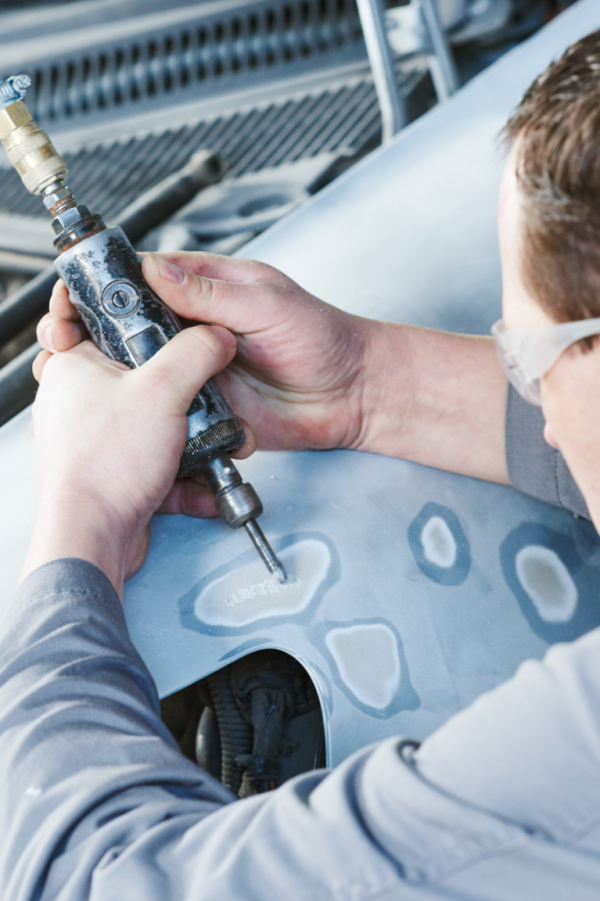
Before jumping into repair options, it helps to know exactly what you’re looking at. Hail damage typically shows up as:
A simple way to check is to run your hand flat across the hood and roof in a well-lit area, or take a look at the car from a low angle so light reflects across the surface and reveals dimpling that’s hard to see from above. For a more detailed breakdown of what to look for, including techniques professionals use during a full assessment, this guide on checking for hail damage on your car walks through the process step by step. Roof damage in particular is easy to miss since it’s rarely at eye level; a dedicated hail damage car roof inspection can catch dents that a casual glance overlooks.
It’s worth documenting everything with photos as soon as you notice damage, both for your own records and for any insurance claim you may file. Photograph the vehicle from multiple angles and in different lighting if possible, since hail dents can be deceptively hard to capture on camera.
Minnesota sits inside what meteorologists call “Hail Alley’s” eastern edge, and the Twin Cities corridor in particular sees more hail-producing storms than most of the country. Hail season in Minnesota runs roughly May through August, with activity climbing sharply in May and June as warm, moisture-rich air moves north and collides with cooler fronts dropping down from Canada. St. Paul and the surrounding metro have logged several billion-dollar, hail-driven insurance loss years in the past decade, which is part of why local body shops see such a heavy seasonal spike in hail-related repair work.
What this means for insurance in Minnesota:
Comprehensive coverage, not collision, handles hail. Hail is classified as a non-collision event, so it’s your comprehensive coverage, not collision coverage, that applies. If you’re not sure which coverages are on your policy, this is worth checking before a storm hits, not after.
Minnesota’s no-fault system doesn’t apply here. Minnesota is a no-fault state, but that system governs injury claims (PIP) after a collision; it has no bearing on vehicle damage claims like hail. Hail damage is handled purely through your comprehensive coverage, regardless of fault, since there’s no at-fault party in a weather event.
You have a legal right to choose your own shop. Under Minnesota Statute 72B.092, insurers cannot require you to use a specific repair facility, pressure you toward a “preferred” shop, or limit your freedom to choose where your vehicle gets fixed. Minnesota Statute 72A.201 reinforces this and outlines how insurers must inform you of that right. A shop can be recommended, but the decision is legally yours.
Aftermarket vs. OEM parts require your consent. Minnesota law also gives you the right to request original manufacturer (OEM) parts for body panels and related components; insurers generally cannot force aftermarket parts as a condition of payment (glass repair is the one common exception).
Knowing these basics before you file a claim puts you in a stronger position- you’re not stuck with whatever shop or process an adjuster first suggests.
Most comprehensive auto insurance policies cover hail damage, since hail is considered a weather-related event rather than a driving accident. That said, the claims process can feel confusing if you haven’t been through it before, and the deductible amount can make a real difference in whether filing a claim makes financial sense.
Here’s generally how the process works:
Depending on your policy and deductible, some drivers find that certain repair programs can significantly reduce or even eliminate their out-of-pocket cost. If your deductible is a concern, it’s worth asking a shop directly about hail damage repair options with no deductible, since programs like this exist specifically to make repairs more accessible without draining your wallet.
When choosing a shop, look for a few key things: certified PDR technicians, a track record of hail-specific work (not just general body shop repairs), transparent estimates that itemize dent counts, and a willingness to work directly with your insurance company on your behalf. A good shop will also offer a lifetime warranty on PDR work, since properly done paintless repair should hold up permanently under normal conditions.
If your car took a hit during a recent St. Paul storm, The Hail Group specializes in exactly this kind of repair, combining paintless dent repair with full auto body support for more severe cases, and works directly with insurance companies to make the process as smooth as possible for vehicle owners.
Not all hail damage is easy to see. Small dents on the roof, hood, trunk, and doors may only become visible under specialized lighting. A professional inspection can identify hidden damage and determine whether paintless dent repair (PDR) is the right solution.
Yes. If the factory paint has not been cracked or chipped, Paintless Dent Repair (PDR) can remove dents without sanding, fillers, or repainting. This process preserves your vehicle's original finish while restoring its appearance.
Most comprehensive auto insurance policies cover hail damage because it is considered an act of nature. Coverage typically depends on your policy and deductible, and many repair providers can work directly with your insurance company throughout the claims process.
Repair times depend on the number of dents and the severity of the damage. Minor repairs may be completed within a few days, while vehicles with extensive hail damage can take longer. After your inspection, you'll receive a more accurate repair timeline based on your vehicle's condition.
Delaying repairs can reduce your vehicle's resale value and allow damaged paint or exposed metal to deteriorate over time. Prompt hail damage repair helps preserve your vehicle's appearance, protects its factory finish, and ensures insurance claims are handled within applicable policy deadlines.
Our Lifetime Warranty covers all repairs conducted by The Hail Group, providing you with comprehensive protection.
With our warranty, rest easy knowing your vehicle's repairs are guaranteed for life, underlining our commitment to long-term customer satisfaction.
As a family-owned business, we pride ourselves on honesty and reliability. Your trust is our top priority, and our warranty is our commitment to you.
Google Reviews

"Fine group of staff! Initially, I met Ben and Joe! I was sold on the service because of their professionalism! Later, I met Logan and Adrian. Great group to work with. I love the way my car turned out. It was worth the wait!"

"Completely awesome and great customer service. this is the second place i’ve been to trying to fix the hail damage on my car and they were the ones who could fix them the best!! like it never even happened!! awesome job!!"

"Amazing people and great service!! They were able to help get the dents out of my vehicle from a recent storm that had passed. Absolutely loved the experience, highly recommended!"