A hailstorm doesn’t warn you. One afternoon, the sky is clear, and a few hours later, your car is sitting in the driveway covered in dents you didn’t have that morning. For drivers in Maple Prairie, that scenario plays out more often than most people expect. Wisconsin’s spring and summer weather patterns bring severe storms through Dane County with surprising regularity, and vehicles parked outside take the hit every time. If you’ve been searching for auto hail repair in Maple Prairie, Madison, WI, you’re in the right place. This guide covers everything you need to know about the damage, the best repair method available, and how to find a team that will handle it right.
What Hail Actually Does to a Vehicle
Most drivers assume hail damage is fairly straightforward: a few dings on the hood and maybe a cracked windshield, but the reality is more involved than that. Hailstones vary in size from small pellets to golf ball diameter and larger, and the force they carry on impact changes dramatically with size. Even smaller hailstones falling at speed can produce dozens of shallow, concave dents across every horizontal and semi-horizontal surface of a vehicle.
The hood and roof absorb the most punishment because they face directly upward during a storm, but the trunk lid, door panels, fenders, and side mirrors often show damage as well. What makes hail damage particularly challenging is that it rarely isolates itself to one or two spots. A moderate storm can leave a vehicle with anywhere from 50 to 200 individual dents spread across multiple panels, and a severe event can push that number significantly higher.
The cosmetic issue is obvious, but the longer-term structural concern deserves equal attention. Paint that stretches across a dent develops micro-fractures over time, and those fractures allow moisture to reach the bare metal underneath. Left untreated, that leads to rust, and rust repair is far more expensive than fixing the original dent ever would have been. According to the National Weather Service, hail ranks among the most consistently costly weather events for vehicle owners across the United States, accounting for billions in property damage each year. Acting quickly after a storm isn’t just about keeping your car looking good; it’s about protecting its structural integrity before a manageable problem becomes a serious one.
Why Paintless Dent Repair Is the Go-To Method
When most drivers picture dent repair, they imagine a body shop sanding down panels, applying filler, and rolling on fresh paint. That method works well for collision damage, but it’s the wrong approach for hail, and most experienced repair professionals will tell you the same.
Paintless dent repair, or PDR, is the industry standard for hail damage because it works with the vehicle’s existing metal and finish rather than covering or replacing them. A trained PDR technician uses specialized metal rods and picks to access the damaged panel from behind, then applies careful, controlled pressure to massage the metal back to its original shape. The process uses no body filler, no sandpaper, and no paint. The factory finish stays completely intact throughout.
This matters for several important reasons. Factory automotive paint goes through a multi-stage baking process that no aftermarket repaint can truly replicate. Any vehicle with documented panel repaints carries a lower resale value because buyers and vehicle history services treat repainted panels as a red flag. PDR sidesteps that problem entirely by preserving what’s already on the car. It’s also significantly faster than traditional bodywork. A conventional repair involving paint application and curing time can stretch to a week or more at a body shop, while a comprehensive PDR job on a hail-damaged vehicle typically wraps up in one to three days.
For drivers dealing with automotive hail damage, PDR isn’t a workaround or a budget compromise. It’s the most effective method available for this specific type of damage, and it’s the reason the entire hail repair industry developed around this technique rather than conventional bodywork.
What to Look for in a Hail Repair Shop
Not every dent repair shop is equipped to handle hail damage, and the quality of PDR work varies considerably depending on the technician’s training and experience. Here’s what to look for before you commit to any shop.
Hail-specific experience matters more than general PDR credentials. A technician who primarily works on minor parking lot dings may not have the skill set to assess and repair a vehicle with 100-plus dents distributed across every panel. Ask directly about the volume of hail repairs they handle and how long they’ve been doing this type of work specifically.
Insurance assistance is another factor worth prioritizing. The Insurance Information Institute points out that comprehensive auto coverage, which covers hail damage, is separate from collision coverage and doesn’t carry the same rate impact as an at-fault accident claim. That means filing for hail damage is often a smart financial move, but the paperwork and adjuster communication involved can slow things down. A shop that handles insurance coordination on your behalf, submitting documentation and communicating with your adjuster directly, removes a significant burden from the driver’s side of the process.
Before agreeing to any repairs, look for a shop that offers a free hail inspection first. A proper inspection goes panel by panel under specialized lighting to document every dent, and that documentation becomes the foundation for your insurance claim and your repair estimate. There should be no pressure to commit to anything before you’ve seen the full picture.
Finally, a written warranty on completed work is non-negotiable. Any shop confident in their technicians and their process will back that up in writing.
What the Repair Process Actually Looks Like
If you’ve never had hail damage repaired before, understanding the process from start to finish removes a lot of the uncertainty.
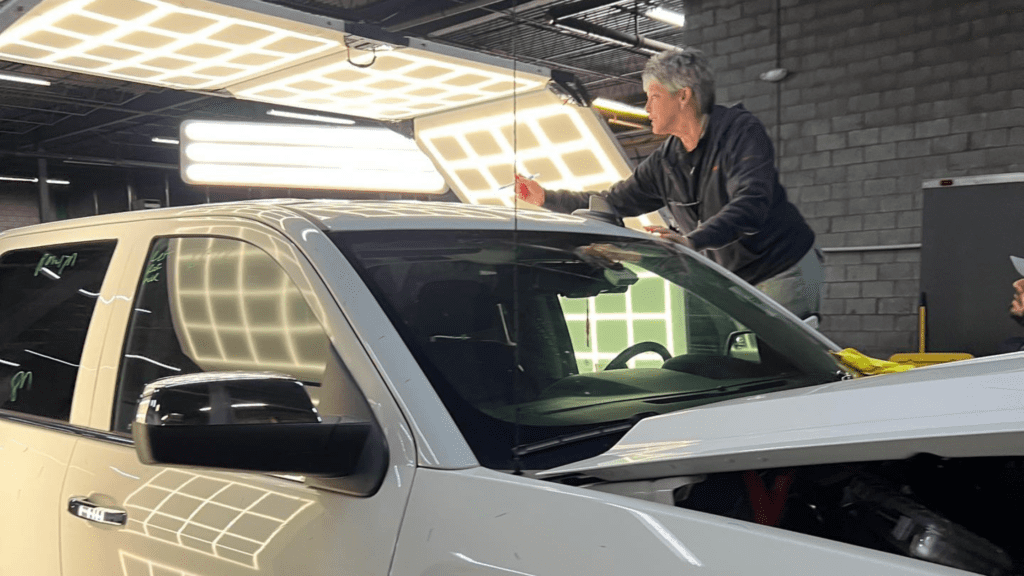
It begins with the free hail inspection. A technician examines the vehicle under precision LED lighting, which reveals dents that standard daylight completely hides, and maps out every affected area. This assessment drives both the insurance documentation and the repair plan, so a thorough inspection at this stage matters more than most drivers realize.
From there, the shop handles insurance coordination. They submit the inspection report and damage documentation to your adjuster, answer any questions from the carrier’s side, and keep the process moving without you having to play middleman. Once the claim moves forward, or if you’re paying out of pocket and the repair plan is confirmed, the actual PDR work begins.
Technicians work panel by panel, using their rods and picks alongside precision lighting to track their progress in real time. The lighting creates a reflection across the panel surface that shows every remaining imperfection as they work, so there’s no guesswork involved. It’s a careful, meticulous process, and skilled technicians don’t rush it. When the work is complete, you walk through the vehicle with the technician for a final inspection before you take it home. Good auto hail repair shops treat this final walkthrough as a standard step, not an afterthought.
Why Location Matters for Maple Prairie Drivers
After a notable storm moves through Madison, every hail repair shop in the area fills up fast. Drivers who act within the first few days get the earliest appointment windows, and those who delay often find themselves waiting weeks for a slot.
Working with a team that serves Maple Prairie directly means quicker access to inspections and repairs when post-storm demand is at its highest. It also means less driving at a time when your calendar is already disrupted by an unplanned car repair situation. Convenience in this context isn’t a luxury; it’s a practical advantage.
Maple Prairie residents who have questions about their options for hail damage repair and deductible coverage should raise that question during the inspection appointment. Depending on the extent of the damage and the specifics of the insurance policy involved, certain situations may allow for repair without an out-of-pocket deductible, and a knowledgeable shop can walk through what applies to your specific case.
Conclusion
Hail damage doesn’t improve with time, and every week a dented vehicle sits unrepaired is another week of potential paint deterioration and declining resale value. Getting professional auto hail repair in Maple Prairie, Madison, WI, means choosing a team that specializes in this type of work specifically, handles the insurance process from inspection through completion, and stands behind every repair with a written warranty. The right shop makes the experience straightforward, and the result is a vehicle restored to what it looked like before the storm.
About The Hail Group
The Hail Group is a trusted provider of paintless dent repair for hail-damaged vehicles serving Maple Prairie and the greater Madison, WI area. Their team offers free hail inspections, manages insurance coordination directly, and uses proven PDR techniques to restore vehicles to their pre-storm condition without touching the factory finish. Fast turnarounds, transparent assessments, and results backed by a real warranty set them apart from general body shops. Schedule your free hail inspection at ushailgroup.com.
Frequently Asked Questions
How soon after a hailstorm should I get my car inspected?
As quickly as possible. Scheduling a free hail inspection within a few days of the storm gives you accurate documentation for an insurance claim and prevents any secondary paint damage from developing around untreated dents. Most reputable shops can accommodate inspections quickly after major storm events.
Will my insurance cover auto hail repair in Maple Prairie?
Hail damage falls under comprehensive auto coverage, which is separate from collision. If you carry comprehensive coverage on your policy, the repair cost should be covered down to your deductible. Filing a comprehensive claim for weather-related damage generally does not raise your premium the way an at-fault accident does.
How long does paintless dent repair take for hail damage?
Most hail-related PDR jobs take between one and three days, depending on how many panels are affected and the total dent count. More comprehensive damage across multiple panels may take slightly longer, but PDR is consistently faster than any traditional bodywork alternative.
Can PDR fix all types of hail dents?
PDR works best when the paint over the dent remains fully intact, and the dent is shallow enough to massage back into shape. The vast majority of hail damage fits that profile. Very sharp creases, stretched metal, or dents with cracked paint may require additional methods alongside or instead of PDR.
Does getting hail damage repaired affect my car’s resale value?
Proper PDR repair actually protects resale value rather than reducing it. Because PDR preserves the original factory paint finish, a repaired vehicle shows no evidence of prior damage in a vehicle history report. Leaving dents unrepaired or using filler-based methods that require repainting both lead to lower trade-in and private sale values.

Josh Jones has been a pivotal part of The Hail Group for over 8 years, bringing his expertise in automotive repair, particularly in hail damage and Paintless Dent Repair (PDR). With a background in both technical and customer-facing roles, Josh is passionate about providing clear, informative content to help consumers make informed decisions about their vehicle maintenance. His goal is to simplify complex topics and ensure that every reader walks away with practical knowledge.
