
Hail damage does not always announce itself loudly. Often, it whispers. We notice it later, when sunlight stretches across a roof panel or glides along the curve of a hood and reveals small interruptions where smoothness once lived. The vehicle still moves. The paint still shines. Yet the surface tells a different story.
We understand that hail damage operates on more than one level. It changes appearance immediately, value gradually, and structural confidence quietly over time. What looks cosmetic today can become a long-term liability tomorrow if handled without precision, discipline, and accountability.
This is where certified auto hail repair becomes essential. Certification is not a label meant to impress. It is a system of standards designed to protect the vehicle, the owner, and the integrity of the repair itself. Certified work aligns technical excellence with insurance compliance, ensuring results that are not only visually complete but formally approved.
Our purpose here is to guide you through how certification shapes every stage of hail repair, from inspection to documentation to final approval, and why it consistently produces higher-quality, insurance-accepted outcomes.
The Importance of Certified Hail Repair
Hailstorms are increasingly frequent in certain regions, and their impact on vehicles is cumulative. A single storm can leave dozens of dents across exposed surfaces. Roofs, hoods, and upper body panels absorb repeated impacts that displace metal in subtle but meaningful ways.
Even minor dents disrupt how light reflects off paint. That disruption affects perceived condition, which influences resale value and appraisal confidence. Over time, improperly addressed dents can lead to paint stress, cracking, or premature surface failure.
Unprofessional repairs introduce further risk. Incomplete dent removal leaves a distortion beneath the surface. Excessive force stretches metal beyond recovery. Repainting eliminates factory finishes and introduces depreciation that cannot be reversed.
Certified auto hail repair exists to prevent these outcomes. It combines verified training, standardized repair protocols, and insurance-aligned documentation. Certification ensures that repairs are performed with intention, evaluated thoroughly, and approved without unnecessary friction.
Section 1: Understanding the Certification Process
Certification in auto hail repair reflects demonstrated competence. It confirms that technicians have completed formal training in Paintless Dent Repair and related specialized techniques. It verifies that they have passed performance testing under controlled standards and continue their education as vehicle materials evolve.
Training focuses on metal behavior, paint elasticity, and structural awareness. Technicians learn how aluminum responds differently from steel. They study how modern clear coats flex under pressure. They practice controlled movement repeatedly until consistency becomes instinctive.
Testing ensures techniques are not improvised. Certification requires proof of repeatable results that preserve factory paint and surface continuity. Continuing education keeps certified technicians aligned with new vehicle designs, modern finishes, and emerging tools.
Certification also enforces adherence to standardized repair protocols. These protocols protect paint integrity and prevent secondary damage. Certified technicians approach complex hail damage methodically, reducing risk and increasing reliability.
Section 2: Comprehensive Damage Assessment
Certified hail repair begins with a thorough assessment. Hail damage often hides in plain sight. Shallow dents disappear under flat lighting and reappear under directional light. Minor distortions accumulate into a visible imbalance when overlooked.
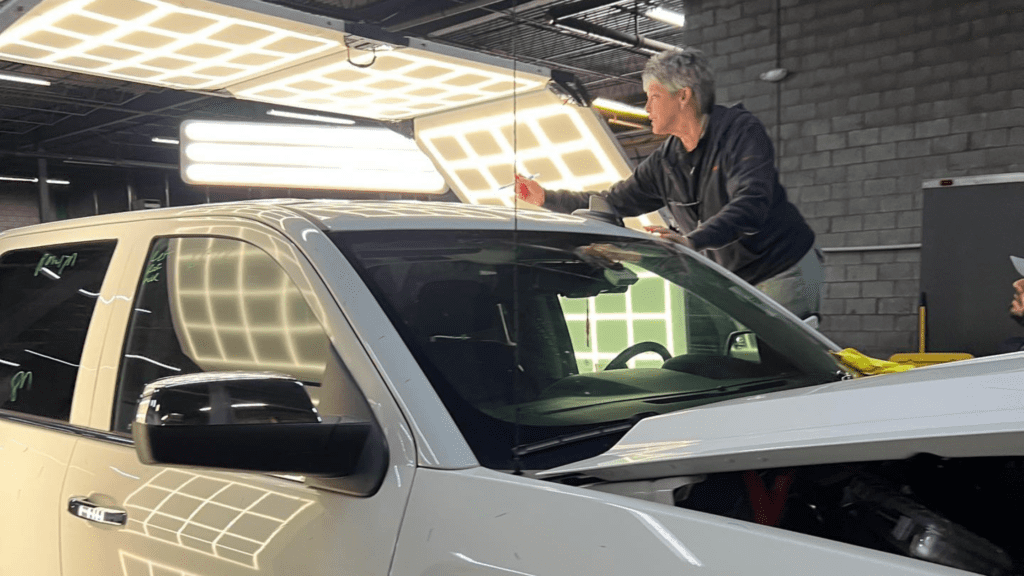
Certified technicians use advanced lighting systems and reflective boards to reveal dent depth and shape. Digital inspection tools map damage across panels, capturing both visible and subtle impacts. This process ensures no area is ignored.
Accurate assessment is critical for repair planning and insurance compliance. Insurers rely on documented damage to approve claims. Missed dents lead to incomplete repairs and disputes later. Detailed inspection creates alignment between technician, insurer, and vehicle owner.
Documentation includes photographs, damage mapping, and repair rationale. This clarity supports comprehensive claims and reduces approval delays. Precision at this stage prevents future deterioration caused by untreated impact points.
Section 3: Precision Repairs Using Specialized Techniques
Paintless Dent Repair remains the foundation of certified hail repair. It restores metal without disturbing factory paint, preserving both appearance and value. This method relies on gradual, controlled movement rather than force.
Certified technicians select techniques based on dent characteristics. Size, depth, location, and surrounding curvature determine the approach. Broad dents require patient massaging. Deeper impacts demand precise pressure. Edge dents call for alternative access strategies.
Consistency defines quality. Certified technicians apply pressure incrementally, monitoring metal response in real time. Hand movements remain deliberate. Tool selection matches panel material and access constraints.
Complex dents often involve layered damage. Certified expertise ensures these are corrected without overstressing metal or compromising paint integrity. Precision replaces speed. Discipline replaces shortcuts.
Section 4: Advanced Tools and Technology
Certification works in tandem with advanced equipment. Specialized tools translate subtle intent into accurate movement. Rods vary in length, flexibility, and tip design. Tapping tools refine surface texture. Knockdowns relieve high spots created during correction.
LED light boards expose distortions invisible under ambient light. Laser measuring devices confirm contour alignment. Digital imaging verifies progress and surface continuity. Technology supports accuracy and consistency rather than replacing skill.
Insurance approval benefits from this precision. Repairs performed with advanced tools are easier to document and evaluate. Insurers recognize standardized methods supported by measurable results.
Efficiency improves without sacrificing quality. Certified technicians complete repairs thoughtfully and thoroughly, protecting the vehicle’s finish while meeting insurance expectations.
Section 5: Insurance Coordination and Approved Documentation
Insurance approval depends on clarity and consistency. Certified repair providers understand insurer requirements and document repairs accordingly. Detailed damage reports, photographs, and repair documentation align with industry standards.
Certified technicians follow recognized repair protocols. Insurers trust these standards because they reduce variability and risk. Proper documentation minimizes disputes and accelerates the claims process.
Coordination ensures repairs meet both technical and insurance criteria. The vehicle is restored correctly, and the claim closes smoothly. Certification bridges craftsmanship and compliance.
Section 6: Quality Assurance and Post-Repair Inspection
Certified repairs conclude with a comprehensive inspection. Reflective lighting verifies surface continuity. Tactile evaluation detects subtle inconsistencies. Digital imaging confirms alignment and finish integrity.
Quality assurance ensures compliance with certification standards and insurance expectations. Any remaining imperfections are corrected before delivery. Follow-up adjustments refine the result rather than conceal flaws.
This final stage protects resale value. It ensures repairs remain invisible under varied lighting conditions and over time. Quality assurance transforms repair into true restoration.
Section 7: Long-Term Vehicle Protection
Certified repairs provide benefits beyond immediate appearance. Preserving original paint reduces the risk of cracking and corrosion. Proper metal alignment prevents stress accumulation beneath the surface.
Additional surface care, such as polishing and protective coatings, supports durability. Certified techniques minimize rust risk and maintain structural strength.
Vehicle owners benefit from guidance on maintaining repairs. Regular washing, protective treatments, and periodic inspection help preserve results. Certified work rewards attentive care with longevity.
Section 8: Selecting a Certified Auto Hail Repair Provider
Choosing a certified provider protects both appearance and value. Credentials matter. Training matters. Experience with insurance processes matters.
Look for transparent communication and documented procedures. Certified providers explain their methods clearly and stand behind their work. They combine skill, technology, and compliance rather than relying on speed alone.
Certification is not a guarantee of perfection, but it is a safeguard against compromise. It signals commitment to standards that protect your investment.
An Artistic Perspective on Restoration
There is an artistic dimension to restoration that mirrors creative disciplines. An artist understands restraint, balance, and patience. They know when to act and when to pause. They respect the original surface rather than overpowering it.
Certified hail repair follows the same philosophy. Metal is guided, not forced. Surfaces are returned, not rewritten. The most successful repair disappears into the form itself, leaving no evidence of intervention.
This artistic mindset elevates repair into craftsmanship. It treats the vehicle as a whole rather than a collection of damaged areas. Precision becomes a form of respect.
Conclusion: Certified Repairs Ensure Optimal Results and Insurance Approval
Certified auto hail repair delivers results built on precision, accountability, and trust. A thorough assessment identifies all damage. Expert Paintless Dent Repair restores metal without compromising paint. Advanced tools support accuracy. Documentation aligns with insurance requirements. Quality assurance protects long-term value.
Certification ensures repairs meet professional standards and achieve insurance approval without unnecessary friction. It restores confidence in both the vehicle and the process.
If your vehicle has experienced hail damage, we encourage you to schedule a free hail inspection to understand its condition and explore certified repair solutions with clarity and confidence.At The Hail Group, our certified technicians combine advanced techniques and industry standards to deliver precise, insurance-approved hail repair results.
