Watching a technician pop a hail dent back into place without a drop of paint or filler almost looks like a magic trick the first time you see it. Car hail dent repair in Kansas City relies on real technique and physics, not luck, and understanding what is actually happening under the surface makes it a lot easier to trust the process and recognize good work when you see it.
Metal body panels have a kind of memory, meaning they want to return to their original shape once the force that dented them is removed, and understanding this basic property is the key to understanding everything else about how the repair process works. Paintless dent repair takes advantage of that property by accessing the underside of a panel, either through existing openings or by carefully removing trim, and gently working the metal back toward its original contour from behind.
Our detailed explainer on how paintless dent removal actually works covers the specific tools and lighting techniques technicians rely on, but the short version is that a skilled technician applies controlled pressure in precise increments rather than forcing the dent out all at once. Rushing this step is exactly what separates a clean repair from one that leaves subtle waviness in the panel, which is why patience matters just as much as raw technical skill in this line of work.
Tools of the Trade
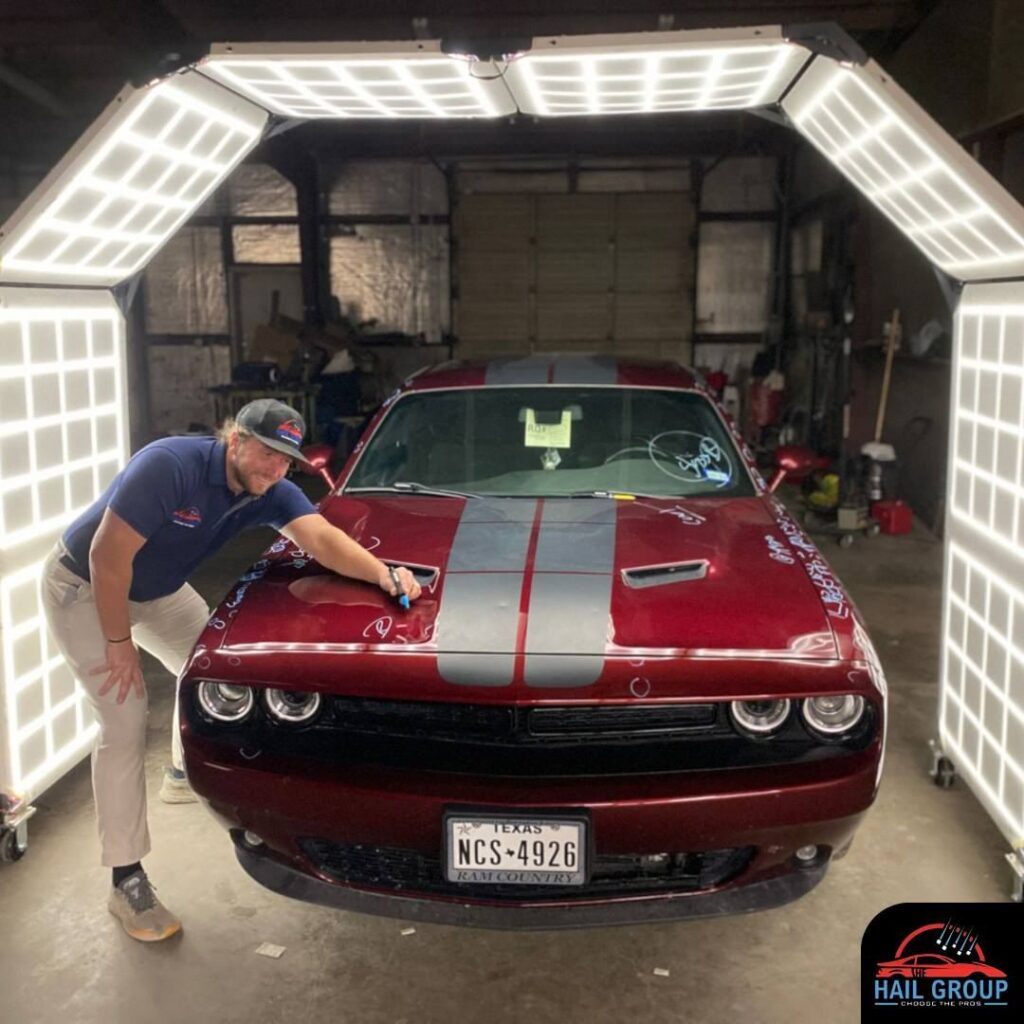
Technicians use metal rods and picks of varying lengths and angles to reach dents from behind panels with limited access points, and each tool is shaped for a specific curve or depth of damage. LED reflection boards play an equally important role, since they reveal a dent’s true shape under controlled lighting conditions that regular daylight simply cannot replicate.
For dents that cannot be reached from behind the panel at all, technicians turn to glue pulling kits, which attach a small tab to the outside of the dent and gently pull the metal back into shape from the front. This method requires a lighter touch and careful judgment, since pulling too aggressively can stretch the metal in ways that are difficult to correct afterward. These same tools handle smaller, everyday dents in addition to hail damage, and the underlying technique carries over directly to storm damage repair on a larger scale as well.
Why Skill Level Matters So Much
Overworking a dent is one of the most common mistakes an inexperienced technician can make, since pushing too hard or too long in one spot can stretch the metal and create a soft, slightly sunken area that is actually harder to fix than the original dent. Experienced technicians develop a feel for exactly how much pressure a given panel can take before that risk becomes real.
Certification programs exist specifically to separate trained PDR specialists from technicians who have only picked up the basics on the job. If you want to see the kind of finished quality a certified technician produces, our before and after gallery shows real examples of panels restored without any repainting at all, giving you a genuine benchmark for what a properly finished repair should look like.
Why Some Shops Cut Corners on This Work
During peak storm season, the sheer volume of hail-damaged vehicles coming through Kansas City shops creates pressure to move faster, and not every shop resists that pressure equally well. Some shops bring in temporary or under-trained technicians during busy stretches, which can lead to rushed work that leaves subtle imperfections a trained eye would catch immediately.
This is exactly why it is worth asking a shop directly about technician certification and how long their core team has worked together, rather than assuming every shop offering paintless dent repair delivers the same quality. A shop confident in its work will answer these questions without hesitation.
What Happens to Severely Dented Panels
Extremely deep dents or sharp creases sometimes only partially respond to paintless techniques, since the metal has been stretched or folded in a way that resists reshaping. In these cases, a small amount of filler and a matched repaint restores the panel fully, and a good shop will explain clearly why that specific panel needs a different approach than the rest of the vehicle.
A combination approach, where most of the vehicle is repaired with PDR and a handful of panels receive traditional bodywork, is common on vehicles that took a particularly heavy hit. Understanding both approaches, and why a shop chooses one over the other for a given panel, helps explain the decision-making behind each one.
How Weather and Timing Affect the Repair Itself
Temperature actually plays a role in how metal responds to paintless dent repair, since colder metal is slightly less pliable than metal that has warmed in the sun. Many shops prefer to work in temperature-controlled bays for exactly this reason, ensuring consistent results regardless of what the weather is doing outside on a given Kansas City afternoon.
This is also part of why booking your repair soon after a storm tends to produce better results than waiting. Fresh dents have not been through repeated freeze and thaw cycles, and the metal responds more predictably to a technician’s tools compared to damage that has sat through several temperature swings over the following weeks or months.
Quality Checks Before Handoff
Reflection board checks confirm that dents are fully resolved rather than just mostly improved, and a thorough technician inspects each panel under multiple lighting angles before signing off on the work. This step catches subtle remaining imperfections that a quick glance in a well lit garage might easily miss, and it is the final safeguard that separates a truly finished repair from one that only looks finished at first glance.
A shop that documents before-and-after results for your own records is doing more than just good customer service. That documentation gives you something concrete to compare against if any issue ever comes up down the road, and it is a fair way to hold any repair shop accountable for the quality of its work. Our page covering how to get small hail dents out of a car and our guide on removing hail dents from a car hood both walk through what thorough, panel-specific repair looks like in practice.
Handling Vehicles With Ceramic Coatings or Multiple Paint Layers
Vehicles with a ceramic coating or multiple layers of clear coat require a slightly more careful touch during paintless dent repair, since these coatings can be more brittle than standard factory paint. Experienced technicians adjust the amount of pressure and the pace of the work to account for this, checking more frequently under reflection lighting to make sure the coating is holding up throughout the process.
If your vehicle has any aftermarket coating or a repaint from before the hailstorm, it is worth mentioning this to your technician upfront. That small detail helps them plan their approach and reduces the odds of any unexpected surprises partway through the repair.
The Role of Mobile Evaluations in Starting the Process
Many Kansas City shops now offer mobile evaluations, sending a technician equipped with portable reflection lighting to assess your vehicle wherever it happens to be parked. This is especially useful right after a widespread storm, when dozens of vehicles in a single neighborhood may need inspection at once.
A mobile evaluation typically covers the same ground as an in-shop inspection, counting and measuring every dent and photographing the damage for insurance purposes. The main advantage is convenience, since you do not need to arrange your own transportation to and from a shop just to get an initial assessment.
What a Warranty Actually Protects You Against
A lifetime warranty on paintless dent repair generally covers the specific panels that were worked on, protecting you if a repaired dent were ever to reappear or if any related issue surfaced down the road. It typically does not cover new hail damage from a future storm, which would require its own separate claim and repair.
Reading the specific terms of a warranty before you commit to a shop is always worth the few minutes it takes, since coverage details can vary somewhat between providers. A shop that offers clear, written terms upfront is generally one that stands confidently behind the quality of its own work.
How Panel Shape Affects Repair Difficulty
Flat panels like hoods and trunk lids are generally the most straightforward surfaces for paintless dent repair, since technicians have relatively easy access from behind and consistent room to work with their tools. Highly contoured panels, including some rooflines and body creases on modern vehicle designs, require significantly more skill, since the metal curves in multiple directions and access from behind is often limited.
Roof panels present their own unique challenge, since many vehicles have limited or no access points behind the roof at all, which sometimes requires headliner removal to reach the metal directly. A technician experienced specifically with roof repair will know exactly how to access these tighter spaces without damaging interior trim or the headliner itself in the process.
Comparing Kansas City Specialists to National Chains
National auto body chains often advertise hail repair as one service among many, but the volume of storm damage a dedicated Kansas City specialist sees each season tends to translate into faster, more consistent results. A shop that repairs hail-damaged vehicles as its primary focus, rather than as an occasional job between collision repairs, typically has technicians who have handled a much higher volume of dents across a wider variety of vehicle makes and models.
That specialization also tends to show up in how efficiently a shop handles insurance paperwork, since a team that processes hail claims constantly develops a much smoother working relationship with the carriers most common in this region. For a repair experience with fewer delays and less back and forth, a specialist with deep local roots is often the stronger choice.
How Temperature and Humidity Affect Scheduling
Kansas City’s humid summers and variable spring temperatures both play a role in how shops plan their repair schedules. Working in a temperature-controlled bay helps technicians maintain consistent results regardless of the outdoor weather, but shops without that kind of controlled environment sometimes adjust their scheduling to avoid the most extreme heat or cold, since metal responds slightly differently at either end of the temperature range.
This is part of why a shop’s physical setup is worth asking about, particularly during the height of summer when Kansas City humidity can be significant. A shop that repairs vehicles indoors in a controlled environment is generally better positioned to deliver consistent results no matter what the weather outside is doing on a given day.
What Sets Apart a Truly Excellent Finished Repair
The difference between an average repair and an excellent one often comes down to details that are easy to miss unless you know to look for them. Run your hand gently across a repaired panel in addition to looking at it, since a perfectly finished repair should feel just as smooth as the surrounding untouched metal.
Check the repaired areas under several different lighting conditions, including bright overhead light, low-angled sunlight, and shade, since a subtle imperfection sometimes only reveals itself under one specific type of lighting. A shop confident in the quality of its work will happily let you inspect the vehicle this thoroughly before you sign off and drive away.
Why This Level of Detail Actually Matters to Drivers
It is easy to assume that hail repair is a simple, interchangeable service from one shop to the next, but the details covered here show just how much skill, judgment, and specialized equipment genuinely go into doing it well. A technician’s experience shapes everything from how cleanly a dent disappears to how long the finished repair holds up over the life of the vehicle.
Understanding this process puts you in a much better position to evaluate any shop you are considering, ask informed questions, and recognize the difference between a rushed job and one performed with real care and precision. The next time hail rolls through Kansas City, that knowledge will make choosing the right repair partner a much easier decision.
Final Thoughts on Trusting the Process
Paintless dent repair can feel almost too simple from the outside, which is exactly why so many drivers underestimate the skill involved until they see a poorly done repair up close. Trusting a certified, experienced technician with your vehicle is the surest way to get results that genuinely hold up over time.
The next time you watch a technician work a stubborn hail dent back into shape, you will have a much better sense of exactly what is happening beneath the surface, and why choosing the right shop for that work matters as much as it does, especially in a market with as much storm activity as Kansas City sees.
Bringing the Right Expectations to Your Own Repair
Armed with this understanding, you are far better equipped to walk into any Kansas City shop and know exactly what questions to ask and what quality to expect in return. That kind of informed confidence tends to lead to a smoother repair experience from the very first phone call through the moment you pick up your finished vehicle, and it turns what could be a stressful ordeal into a straightforward, well-managed process from start to finish, regardless of how severe the storm damage turned out to be.
Conclusion
Understanding how car hail dent repair in Kansas City actually works, from the science behind the metal’s memory to the specific tools technicians rely on, makes it much easier to trust the process and recognize a job that has been done well.
Get Started
The Hail Group’s certified technicians bring precision and patience to every panel, restoring vehicles without touching the factory paint whenever possible. Request a free hail inspection and see exactly what your car needs to look like new again.
Frequently Asked Questions
Does paintless dent repair work on all types of hail dents?
It works very well on shallow, unpainted damage, but it is not the right fit for cracked paint or sharp, deeply creased dents.
How long does a technician typically spend on a single dent?
It varies from a few minutes for small dings to over an hour for larger, more complex dents, depending on size and access to the panel.
Can paintless dent repair be detected later, for example at resale?
No, done correctly, it leaves no visible trace at all, since the original factory paint is never disturbed during the process.
What kind of training do PDR technicians need?
Most go through hands-on apprenticeship followed by certification programs specific to paintless dent repair, which is different from general auto body training.
Is paintless dent repair safe for aluminum body panels?
Yes, with technicians adjusting their technique and tools slightly, since aluminum behaves differently under pressure compared to traditional steel panels.

Josh Jones has been a pivotal part of The Hail Group for over 8 years, bringing his expertise in automotive repair, particularly in hail damage and Paintless Dent Repair (PDR). With a background in both technical and customer-facing roles, Josh is passionate about providing clear, informative content to help consumers make informed decisions about their vehicle maintenance. His goal is to simplify complex topics and ensure that every reader walks away with practical knowledge.
