Body filler and a fresh coat of paint can hide a dent, but they never restore a panel the way it left the factory Auto hail dent repair in Lakewood done with paintless techniques fixes the metal itself, and that difference shows up in durability, finish, and the long-term value of your car. Once you understand how the two methods really compare, the choice gets easy.
Lakewood knows hail well. The city has taken some of the worst of it over the years, including a storm that left it among the hardest hit areas in the metro. When your car sits dented in the driveway after a storm like that, the repair method you pick matters more than you might think.
What traditional bodywork actually does
Conventional repair tackles a dent by reshaping the surface rather than the metal underneath. A technician grinds off the paint, fills the low spot with body filler, sands it level, applies primer, then repaints the panel and tries to blend the new color into the old. It is a multi-step process built around covering the damage rather than reversing it.
It works in the moment, but it comes with trade-offs that surface later:
- Filler bridges over the dent instead of removing it, so the original contour of the metal never fully returns.
- Sanding and respraying strips away the durable factory finish and replaces it with a new one applied under lesser conditions.
- Over time, filler can shrink and crack, and repainted areas can fade or mismatch in Colorado’s harsh sun and freeze-thaw swings.
- Grinding through the paint can expose bare metal, which raises the long-term risk of rust if any moisture gets in.
A climate full of temperature swings and intense high-altitude sun is exactly the kind of environment where those weaknesses tend to show.
How paintless dent repair is different
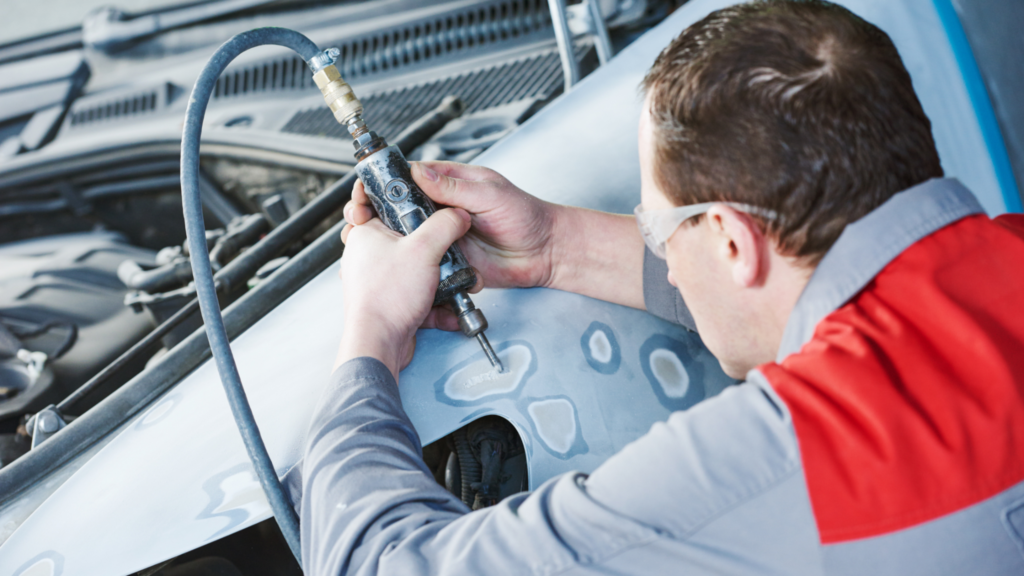
Paintless dent repair fixes the actual problem. A technician works the metal from behind the panel, gently coaxing it back to its original shape using specialized tools and reading lights, without filler, sanding, or paint. When the job is done, there is usually no sign that a dent was ever there.
Because nothing covers or replaces the original surface, your factory paint stays exactly as it was. That is why automakers and insurers treat it as the standard. Manufacturers themselves demand paintless repair on dents found in brand new vehicles, and insurers prefer it because it preserves the finish, protects safety features, and leaves the manufacturer’s warranty intact. Our paintless dent repair page walks through the full process step by step.
Hail damage suits this method perfectly. The dents are shallow and round, the paint stays whole, and the metal has room to return to form, which is why even a car covered in hundreds of dents can come back looking untouched.
The finish and durability gap
This is where the two methods truly separate. A paintless repair leaves the original baked-on factory finish in place, which is harder and more uniform than anything a shop can spray on later. There is no overspray, no texture mismatch, and no filler waiting to crack as the seasons turn.
A traditional repair, by contrast, introduces filler and fresh paint that can break down over time. Even a well-done respray ages differently than the surrounding factory paint, and the difference grows more visible with every Colorado summer and winter. For durability and appearance, the paintless approach holds up better for far longer.
Safety features and modern finishes
There is a modern wrinkle worth knowing. Today’s vehicles carry sensors, cameras, and driver-assist systems, and many owners add ceramic coatings or paint protection film. Because paintless repair works entirely from behind the panel and never disturbs the outer surface, it leaves those finishes and systems undisturbed. A respray, by contrast, can mean re-applying coatings and recalibrating systems, which adds cost and complexity that PDR simply avoids.
Long-term ownership benefits
The advantages do not stop at the repair itself. They follow you for as long as you own the car and right up to the day you sell it.
Keeping the factory finish pays off in several ways:
- Stronger resale and trade-in value, since original paint signals a clean, well-kept vehicle.
- Fewer future problems, because there is no filler to shrink and no repaint to fade.
- Lower risk of rust, since the protective factory coating stays unbroken.
- Warranty-backed confidence, with a lifetime warranty standing behind the repair.
Those benefits add up to a car that looks better, lasts better, and sells for more down the road.
What to expect when you bring your car in
Knowing how a paintless repair unfolds takes the mystery out of the decision. It starts with a careful inspection under specialized lighting, where a technician maps every dent and confirms the paint is intact enough for paintless work. From there, you get a clear picture of the plan and the timeline before anything begins.
The repair itself is patient, methodical work. A technician reaches behind each panel, often removing trim or interior pieces to gain access, then uses precise tools to coax the metal back to its original contour one dent at a time. There is no noise from grinders, no spray booth, and no days lost to drying paint. The car simply returns to the shape it held before the storm.
When the work wraps up, a final pass under the same lighting confirms the dents are gone from every angle. Because nothing on the surface changed, there is no curing period, no color to match, and no break-in for new paint. You get your car back looking like the storm never happened, with the original finish fully intact and a warranty standing behind the repair. That straightforward, low-disruption experience is a big part of why drivers and insurers alike keep choosing the paintless route.
Does paintless repair handle severe hail damage?
A common worry is that a car hit hard, the kind with dents on every panel, is too far gone for paintless work. In most cases, that is not true. The number of dents does not change whether the method works, only how long it takes. As long as the paint stays intact and the metal has not stretched past recovery, a skilled technician can restore even a heavily damaged car to its original shape, dent by dent.
Severe storms do raise the odds of a few complications, such as cracked paint on the sharpest impacts or a panel dented along a tricky edge. Those specific spots may call for another approach, but they rarely rule out paintless repair for the rest of the car. A thorough inspection sorts the dents that PDR can handle from the few that cannot, so you get the maximum benefit of the finish-preserving method wherever it applies.
The takeaway is reassuring. Heavy damage does not automatically mean filler, respray, and a diminished car. More often, it means a longer paintless repair that still returns your vehicle to its factory finish, which is exactly the outcome you want after a rough storm.
The bottom line on the method
Auto hail dent repair in Lakewood done with paintless techniques beats filler and respray on nearly every measure that matters, from finish and durability to resale value. It fixes the car instead of covering the problem, and it keeps the original paint that makes your vehicle worth more.
The Hail Group relies on paintless dent repair, trusted by insurers and manufacturers alike, backed by a lifetime warranty and an A+ BBB rating. We serve Lakewood and the greater Denver area with skilled technicians and a focus on doing hail repair right the first time. Schedule a free hail inspection and see the difference real PDR makes for your car.
Frequently Asked Questions
Is paintless dent repair really better than body filler?
For hail damage with intact paint, yes. PDR restores the actual metal and keeps your factory finish, while filler covers the dent and can crack or shrink over time, especially in Colorado’s climate.
Does PDR last as long as traditional bodywork?
It often lasts longer. Once the metal returns to its original shape, it stays that way, and there is no filler or respray to break down later down the line.
Will paintless repair match my factory paint?
There is nothing to match, because PDR never touches your paint. Your original factory finish stays exactly as it was, which avoids the color mismatch that respraying can cause.
Do insurance companies prefer paintless dent repair?
Yes. Insurers favor PDR for hail because it preserves the finish, costs less, and returns cars faster, and adjusters frequently write estimates specifically for it.
Can every hail dent be fixed with PDR?
Most can, as long as the paint is unbroken and the metal has not stretched too far. A quick inspection confirms which dents qualify and flags any that need another approach.

Josh Jones has been a pivotal part of The Hail Group for over 8 years, bringing his expertise in automotive repair, particularly in hail damage and Paintless Dent Repair (PDR). With a background in both technical and customer-facing roles, Josh is passionate about providing clear, informative content to help consumers make informed decisions about their vehicle maintenance. His goal is to simplify complex topics and ensure that every reader walks away with practical knowledge.
